Philosophy
2026

This work is rooted in Newfoundland and Labrador — in its coastlines, its fishing communities, and my own family’s history within them. Growing up with an ancestral connection to the ocean and the fishery, I became attuned to a particular kind of architecture: the stages, stores, and flakes built directly from necessity, shaped by the rhythms of catching, processing, and preserving cod. These structures are not incidental to the landscape — they are expressions of it, built against and upon rock of extraordinary age and origin.
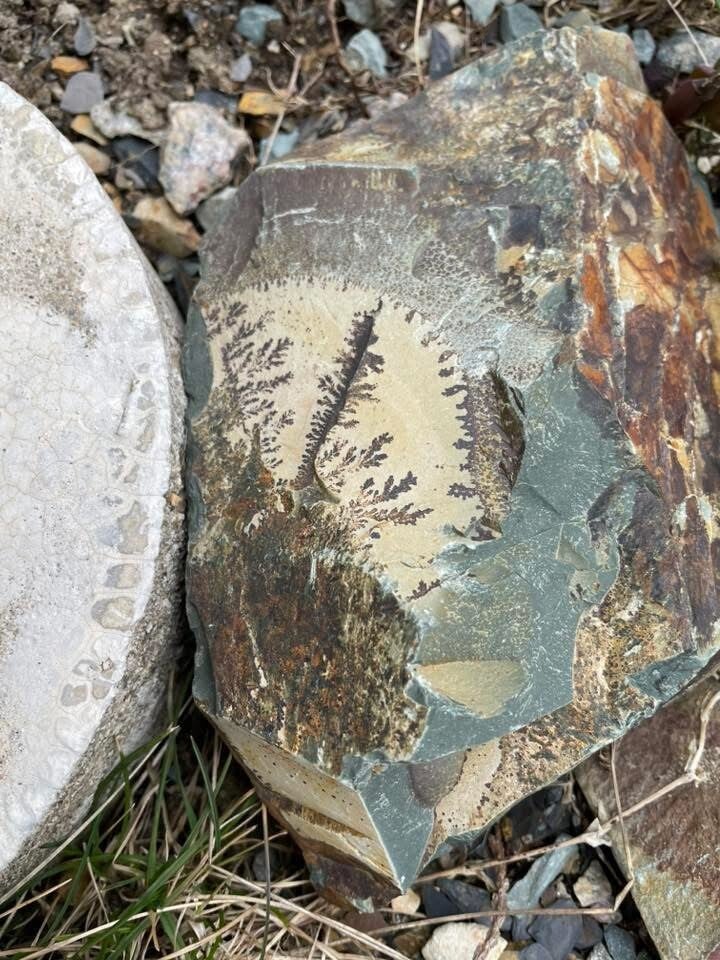
Newfoundland carries the geological memory of Gondwana, the ancient supercontinent, in formations that were once part of another world entirely before drifting to become this shore. Nowhere else on Earth are such ancient and varied geological sequences so openly exposed — folded, fractured, and coloured in ochres, greens, and greys, shaped into forms that feel both alien and deeply familiar. This exposed geology is not backdrop but presence, an aesthetic force that runs through the landscape with the same insistence as the sea. Against this deep time, the collapse of a fishery and the disappearance of a vernacular architecture register as urgent, immediate losses — a single human lifetime measured against hundreds of millions of years of stone.
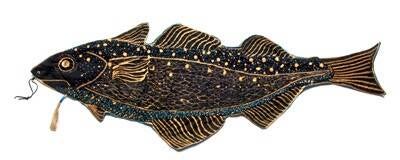
Working with fish skin leather, I discovered a material practice that mirrors this larger inquiry: a way of transforming remnant into meaning, of keeping an embodied record of a culture and an ecology in the midst of profound loss. The inspiration is personal, but the questions it raises — about disappearance, about memory, about what we make from what is left — reach far beyond any single shoreline.
The Artist

a post-disciplinary artist and educator whose practice is an ongoing discourse on the relationship between humanity and the natural environment in the Anthropocene. A graduate of the Nova Scotia College of Art and Design (NSCAD), she draws on a 30-year career that spans textiles, sculpture, and global activism to create works that layer meaning through stitching, painting, and found materials.
Her latest work, Sentinel, serves as a witness to this delicate ecological balance. Embodying her philosophy of "stitching, not ditching," the piece reflects her commitment to environmental sustainability and her decade of leadership with Oxfam Canada, where she served as National Board Chairperson. Informed by her travels from the heights of Mt. Kilimanjaro to her home in St. John’s, Newfoundland, Bruton’s art challenges viewers to reconcile our shared history with the natural ecosystems that sustain us.
Whether through her Mending Factory initiative or her roles as an Artist-Educator, Bruton continues to use the intimate, tactile nature of cloth as a record of both time and transformation.
Remembrance collection 2026
Remembrance is an evocative exploration of place, heritage, and the accumulated gestures of working lives. In this series, the traditional fishing culture of Newfoundland and Labrador is honored not merely as a historical anchor, but as a living, breathing relationship with the natural world. By marrying archival echoes with contemporary, humble materials directly from the fishery—cloth, thread, and marine textures—the work bridges the space between continuity and change. Each piece serves as a tactile non-verbal language, holding space for what has been lost while paying quiet reverence to the resilient hands that have shaped our coastal communities.


KEEPING CONNECTED 2025 City of St. John's Permanent Collection
MISTAKEN POINT 2012
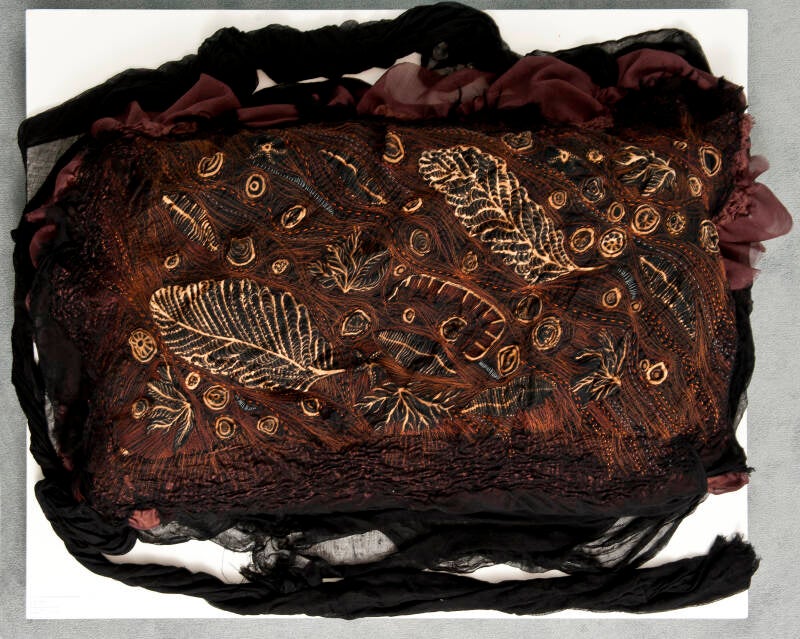
Mistaken Point
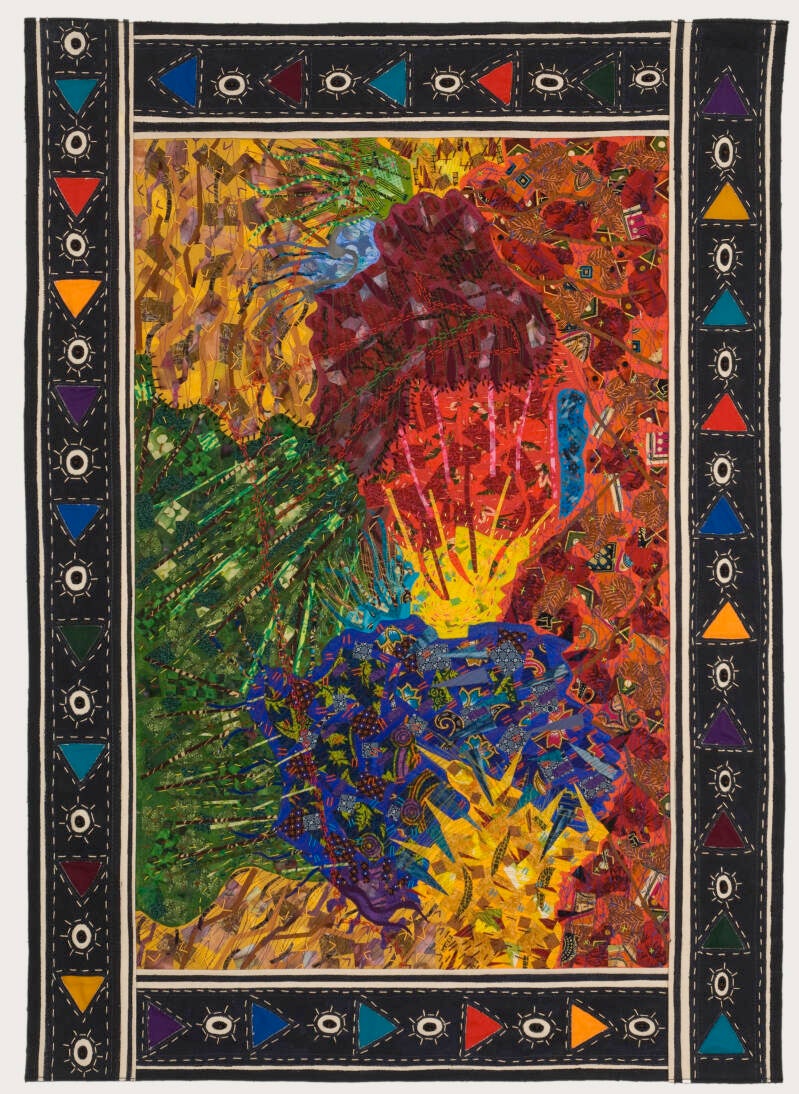
Mistaken Point 2012
top right - ORIGINS - techtonic plates and Artist's movements
Bottom Right - Mistaken Point - sculpture - Edicaran Fossils
Left - Gondwana
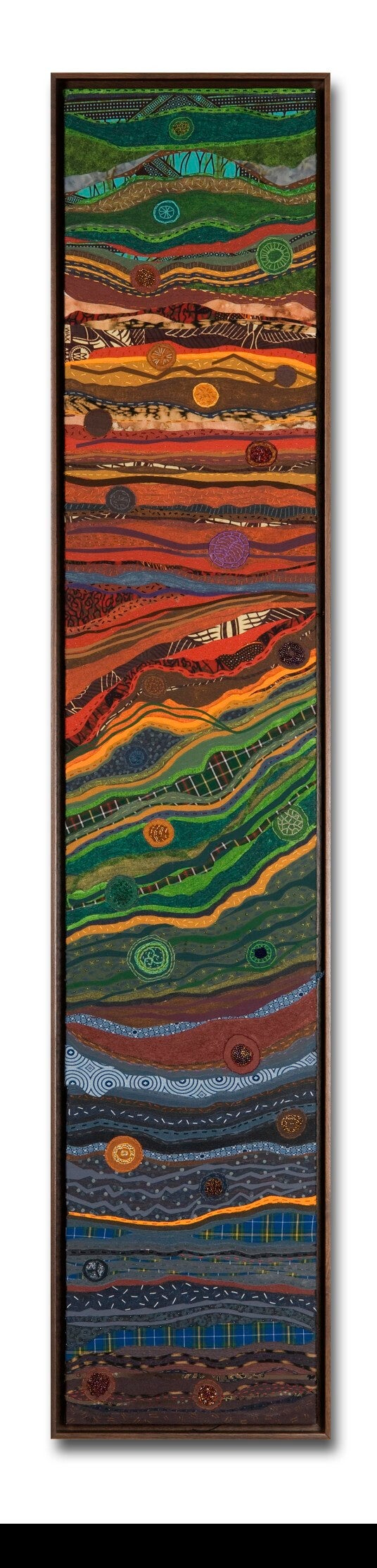
At Mistaken Point, delicately preserved by ash in the rocks is the aftermath of a natural catastrophe. These rock beds in the southeastern point of Newfoundland are part of the same ancient seabed found in the mountains of North West Africa and hold the oldest known traces of life on earth. Surrounding this ancient fossil bed the black stratum of rock bears witness to the ash that trapped and preserved them 650 million years ago. Walking on this ancient ocean floor, my feet and hands touching traces of the beginnings of life, I felt comforted by the ancient connection to Africa and reminded of the temporal nature of life.
The fine thin layer of ash, a protective layer, this ultimate textile had preserved this community of deep ocean life forms so carefully this ignited my sense of wonder and inquiry about Mistaken Point.
I am documenting a natural and cultural history of a landscape. My personal relationship with Mistaken Point is part of that story. I have chosen textile techniques that mimic geological processes that shaped the land. By cutting through and extracting = erosion, layering = deposition, resisting and binding = fossilization, unraveling = decay.
Like layers of thought, I build up the surface of my textile works with drawing, stitching, painting and discharge to invite the cloth to take form and record my artistic process as the earth records the passage of time.
https://youtu.be/jE_wDeHvAV4?si=XOKllTL4unsHfUYJ
Contact us
Reach out to us with any inquiries or custom orders. We'd love to hear from you!
About us
The Cod Room is a studio based in St. John's, Newfoundland and Labrador, Canada. I am passionate about sustainability and creativity, using cod skin to create exquisite leather objects that celebrate the beauty of nature.